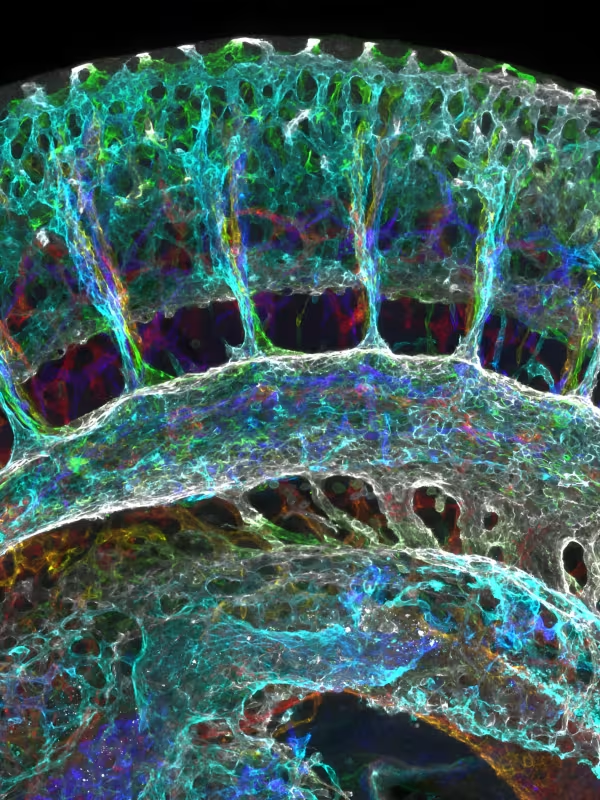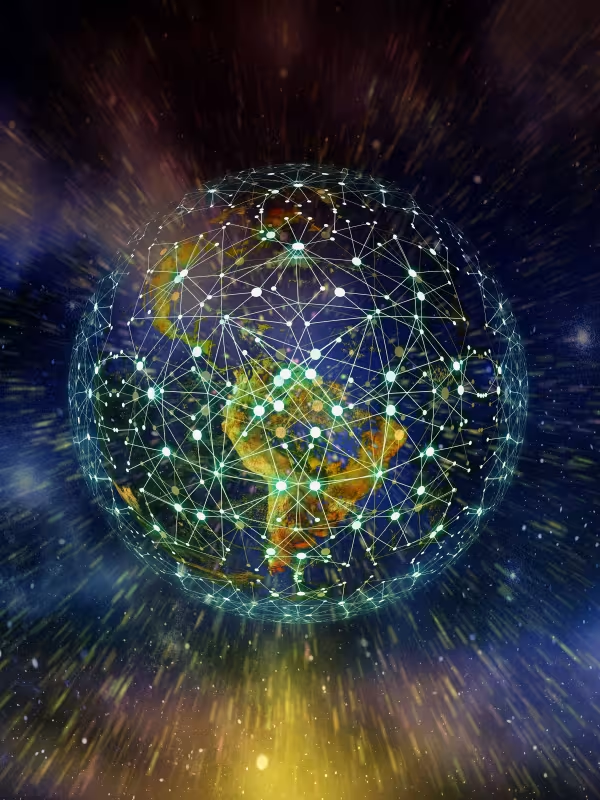

As environmental degradation accelerates globally, Nature is becoming increasingly mediated through screens, sensors, and simulations: datafied, downloaded, and deciphered; saved, stored, and shared. Emerging technologies create novel visual regimes through which humans encounter, imagine, and interpret the other-than-human world. These visual regimes are not only technical; they also refashion ecological aesthetics, shaping how environments are perceived, valued, and cared for.
Wildlife webcams promise unmediated intimacy with living beings, while artificial intelligence (AI) fabricates hallucinatory ecologies untethered from the web of life. “Digital twins” offer ecosystems from an impossible nowhere-everywhere vantage (a rearticulated ‘god trick’), while Virtual and Augmented Reality technologies layer and curate space, and attention at the whim of their designers. From TikTok feeds to satellite imagery, these proliferating techniques of visualisation not only mediate ecological knowledge but also stage new aesthetic and political relations between humans and their environments.
Visualisation practices—often employed uncritically or devoid of social, cultural, and historical context—form a key part of emergent forms of modelling, prediction, and analysis in science, engineering, and architecture. Emergent visualisation practices are not neutral; they carry material, affective, and political implications for increasingly precarious ecologies. The implications of these practices, therefore, fundamentally alter the politics of environmental governance and knowledge. From the advertising boards of property developers to contemporary documentary film, this emerging visual regime is characterised by, among other things, curation, artificiality, and abundance. What is at stake, then, in this evolving visual politics of ecologies? How might we characterise this emerging visual regime? How is nature visually presented?
The Visual Politics of Digital Ecologies conference will collectively explore visual metaphors, practices, spaces, and scales prevalent in the mediation of more-than-human worlds to interrogate how digital technologies are refashioning ecological aesthetics. The two-day conference will showcase contributions from academics, artists, and practitioners. Papers will speak to a particular action of visualisation, including: capturing, compositing, rendering, mining, mirroring, and more.
We are delighted to welcome Joanna Zylinska (Professor of Media Philosophy + Critical Digital Practice, Department of Digital Humanities at King's College London) and Alexandra Daisy Ginsberg (Recent recipient of the S+T+ARTS Grand Prize and internationally renowned multimedia artist) as our keynotes. A full schedule will be shared with ticket holders in advance.
This event is part of the Cheng Kar Shun Digital Hub Programme with support from: the School of Geography and the Environment; Jesus College, Oxford; St John’s College, Oxford; and the Economic and Social Research Council (ESRC).
The conference fee includes refreshments, lunch, and a drinks reception. Catering will include vegetarian, vegan, and gluten-free options, and allergens will be clearly labelled. If you have any additional dietary requirements or allergies, please do contact digitalhub@jesus.ox.ac.uk and we are happy to help.
*Filming and photography will be taking place during the event. If you do not wish to be photographed or filmed, please notify a member of the Hub team on arrival.
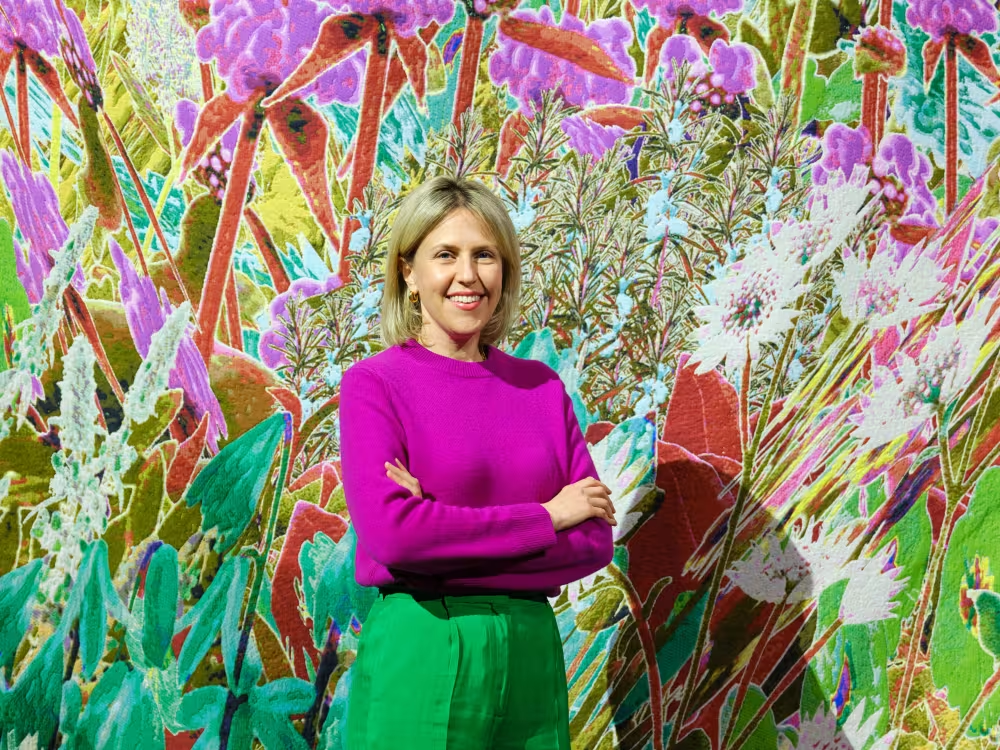
Alexandra Daisy Ginsberg, b. 1982, London, is a multidisciplinary artist known for complex projects that challenge our understanding of “nature” by collaborating with scientists and using emerging technologies. Her recent works include rebuilding the dawn chorus using machine learning, resurrecting the smell of extinct flowers, and simulating the wilding of Mars. Ginsberg’s recurring focus is on the intersection of art, ecology, and technology. In 2023, she won the S+T+ARTS Grand Prize – Artistic Exploration for her experimental interspecies living artwork, Pollinator Pathmaker. Her work is exhibited globally at institutions including MoMA New York, the Centre Pompidou, and the Royal Academy of Arts. Her pieces are also held in permanent collections, including the Art Institute of Chicago and the Cooper Hewitt Smithsonian Design Museum. Recent commissions include a large-scale video installation for Google’s Gradient Canopy office in Mountain View and an 8-metre tapestry for London’s Design Museum.

Joanna Zylinska is a writer, artist, curator and Professor of Media Philosophy + Critical Digital Practice at King’s College London. She is an author of a number of books – including The Perception Machine: Our Photographic Future Between the Eye and AI (MIT Press, 2023, open access), The End of Man: A Feminist Counterapocalypse (University of Minnesota Press, 2018; open access) and Minimal Ethics for the Anthropocene (Open Humanities Press, 2014, open access). Her own art practice involves experimenting with different kinds of image-based media. She is currently researching new image ecologies, while trying to map out scenarios for alternative futures.